What Actually Releases in a Session?
When talking about myotherapy and fascia work, we often hear phrases like “releasing the fascia” or “opening the fascia”.
These phrases can be useful for describing the change felt during a session. But they fall a little short when it comes to explaining what is actually happening in the body. Because fascia is not a simple structure that opens and closes when force is applied to a point.
Fascia is a living connective tissue network that surrounds, connects and shows continuity throughout the body — around muscles, bones, organs and other tissues. Its structure includes collagen and elastin fibres alongside a water-rich extracellular environment. Hyaluronic acid, one of the components of this environment, also plays a role in enabling fascia layers to slide over one another.
Thinking of what happens during manual contact as simply “pressing on tissue” is not sufficient.
Does Fascia Really “Open”?
Pressure and movement applied to tissue can influence the mechanical behaviour of that tissue in the moment. Temporary changes may occur in the way layers slide over one another and in the movement capacity of the region.
Research suggests these mechanisms may play a role in the effects felt after manual applications. But to say from this that we are “directly moving the fluid inside the fascia” or “breaking adhesions with our hands” goes beyond what our current knowledge supports.
When we say “the fascia opened”, we shouldn’t think of this as a physical adhesion breaking apart. A more accurate way of speaking is to refer to changes in the tissue’s capacity to move and for layers to slide over one another.
Touch Is Also a Sensory Experience
Fascia is a tissue rich in sensory nerve endings. Information relating to stimuli such as touch, pressure, stretch and movement is continuously relayed to the nervous system.
This means that when slow, controlled contact is applied to a region, we are not only influencing the mechanical properties of the tissue. We are also offering the nervous system new sensory information about that region.
This information can affect how a person perceives that region, how they organise movement, and how they experience pain. Some of the changes in muscle tone seen during or after a session may be related not only to the mechanical force applied to the muscle, but also to the response the nervous system gives to this stimulus.
This is why more force doesn’t always mean more effect. Sometimes slower, lighter contact — continuously adjusted in response to the person’s feedback — can be far more meaningful.
Why Does Contact Change Throughout a Session?
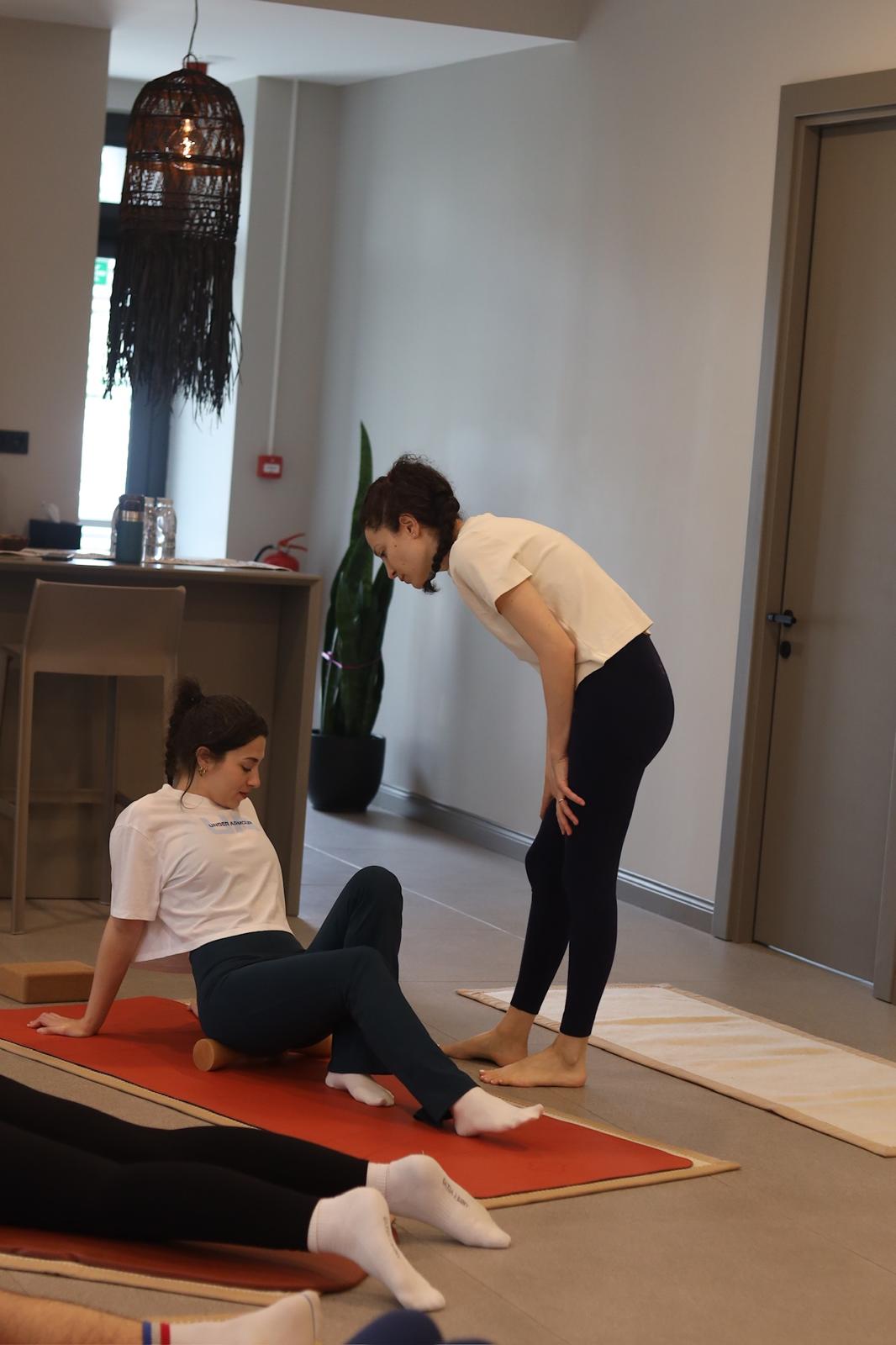
This is one of the reasons contact in myotherapy is not applied like a fixed technique. Rather than applying the same pressure to the same point continuously, contact can shift according to the tissue’s response, the person’s breath, their movement, their comfort threshold, and their sensory experience in that moment.
The direction, pressure and duration of contact can be adjusted; sometimes movement or breath is also brought into the work. In this way, the application moves away from being a one-directional intervention imposed on the body and becomes a process shaped by the person’s own feedback.
What Might Have Changed After a Session?
After a session, a person may say “that area has opened”, “I’m moving more freely”, or “my body feels lighter”. This experience is real — but it doesn’t indicate that a single structure has relaxed.
Several processes may be playing a role together in the change felt: the mechanical behaviour of the tissue may have shifted, the way fascia layers slide over one another may have been influenced, muscle tone may have changed, sensory perception of the region may have shifted, or the person may have begun to experience movement as less threatening.
The body doesn’t work like a machine whose parts operate separately. It works like a living system that continuously receives information, responds, and reorganises itself.
Being Able to Use the New Range of Movement
The capacity of tissue changing is one thing; the body being able to use that new capacity is another. This is why integrating movement, breath or different positions into the process after manual work can be meaningful.
The body doesn’t only experience a new range of movement — it also gains new sensory information about how it can use that range. For the change that emerges during a session to transfer into everyday movement, the body needs to experience this possibility.